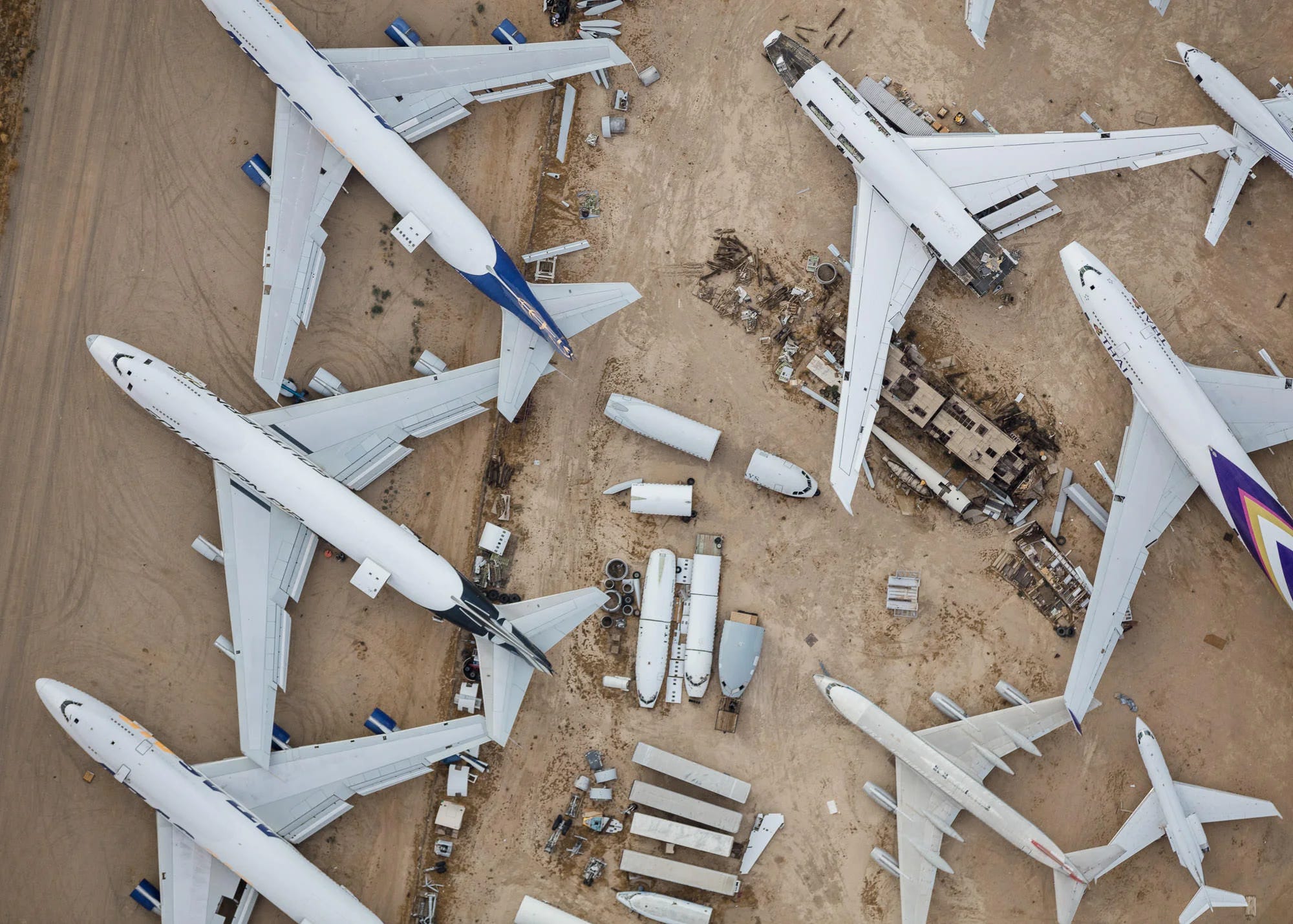
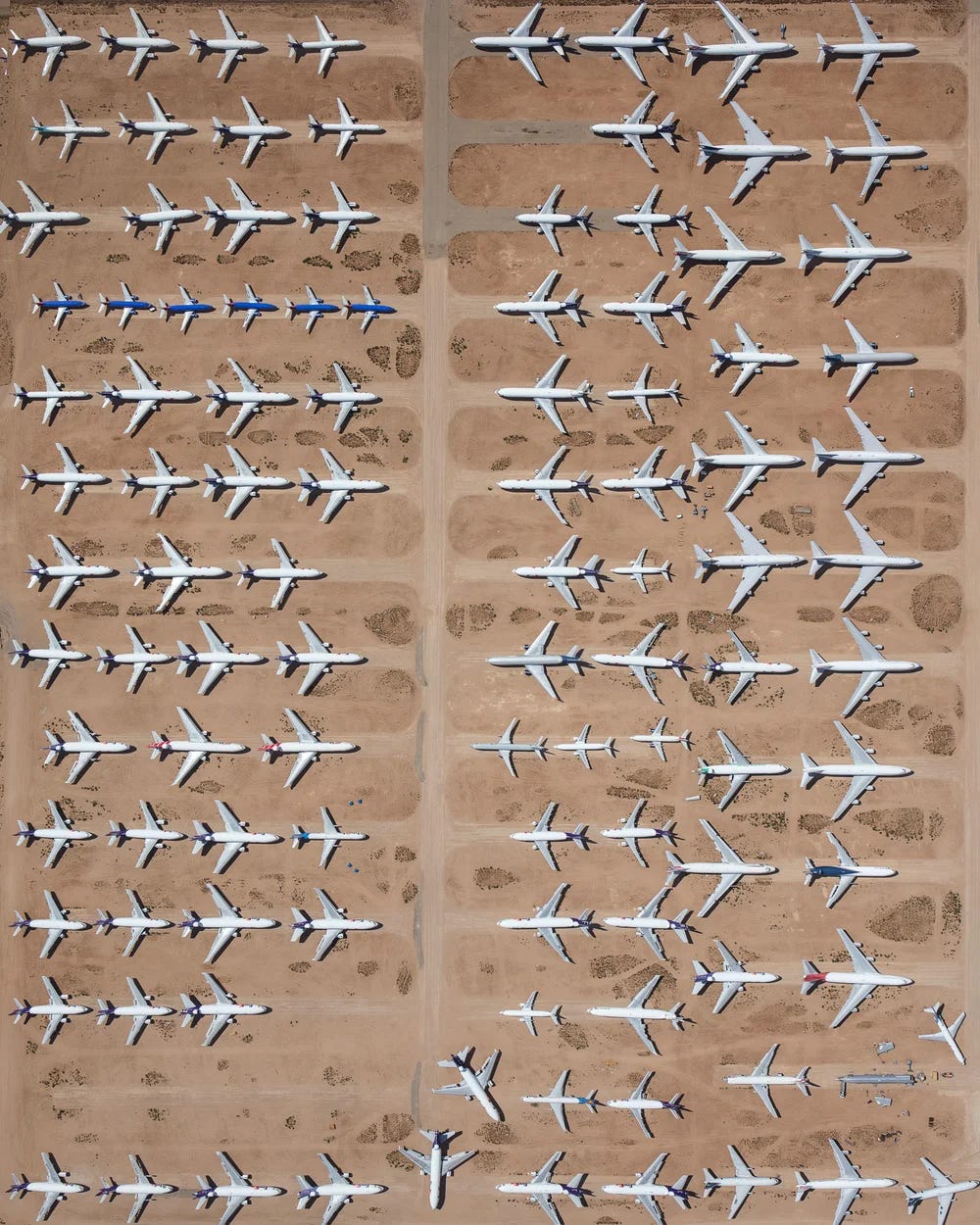
It might not be the most important story in the world right now, as our species takes its first halting steps into a brave new world of technological power whose contours are still to us mysterious and weighted with fearful portent, but lately I’ve been spending a good bit of time reading about the death of Spirit Airlines. Spirit, for those lucky enough to have never flown on one of its planes—I have a few memories of terrible Spirit flights from New York to Miami in my teenage years—is, or rather was, one of the ten or so largest airlines in the United States, and, after its more popular rival Southwest, the most prominent of the budget airlines. (JetBlue is somewhat larger, but can’t be considered a “true” budget airline.) And, for the last few years, Spirit had been hurtling toward insolvency.
Spirit had last turned a profit in 2019; things turned disastrously bad with the COVID pandemic in 2020—as was the case for every other airline—but whereas larger flyers generally recovered, things went from bad to worse for Spirit. Corporate leadership pursued a merger with JetBlue, but this was blocked by a federal judge. And so in November 2024, Spirit filed for Chapter 11 bankruptcy protection; then it filed again, less than a year later, in August 2025. But these filings did little to save Spirit. There was talk of liquidating the company. The Trump administration raised the prospect of a capital injection that would leave the federal government with a 90 percent stake in the airline (the first time in American history that the federal government has owned a passenger airline outright), but the talks collapsed, and so in early May 2026 Spirit announced that it was shutting down for good.
The collapse of Spirit was unique in that in its death throes it managed to solicit a bailout offer from the U.S. government; but it was not unique among its fellow airlines in going broke. Airlines are a bad business: a really, really bad business. The International Air Transport Association, the trade body of the global airline industry, has documented for years that airlines as a sector destroy investor value in the aggregate. The IATA’s 2026 outlook, looking forward to a quite strong year—this was before the Iran war broke out and oil prices surged—projected an average return on invested capital of 6.8 percent, against a weighted average cost of capital of 8.2 percent. As the IATA’s report said, “the airline industry collectively does not generate earnings that cover its cost of capital.” This has been the case for a long time. From its deregulation in 1978 to the end of 2025, the airline industry has cumulatively lost money: its net profit over those 47 years sits at negative $37 billion.
Given these grim economics, you won’t be surprised to hear that airlines have a bad habit of going insolvent. This includes many of the most famous names in the history of aviation. Pan Am, long the unofficial flag carrier of the United States, ceased operations in 1991; Eastern Air Lines liquidated the same year; TWA, the carrier of Howard Hughes, was absorbed into American Airlines after a third bankruptcy filing in 2001; Braniff died in 1982. And those are only the most famous names; countless aviation startups have come and gone. (Have you ever heard of Trump Shuttle?) Even airlines with the backing of a national government go bankrupt all the time: Alitalia, Italy’s flag carrier, reported only a single year of profit since its founding in 1946 and was saved countless times by the Italian government before ultimately ceasing operations in 2021. Even those airlines that survive for long periods of time are perpetually in financial distress. Between 1978 and 2005, more than 160 airlines filed for bankruptcy; virtually every major U.S. carrier other than Southwest has been to bankruptcy court at least once. In September 2005, every one of the four largest American airlines—United, Delta, Northwest, and US Airways—was operating simultaneously under Chapter 11 protection.
This is very strange. There’s not really a conventional economic explanation for an industry whose long-term equilibrium is losing money: an industry that, on a purely economic level, should not exist. Warren Buffett once called the airline industry a “bottomless pit” for investor capital. “Indeed,” he wrote, “if a farsighted capitalist had been present at Kitty Hawk, he would have done his successors a huge favor by shooting Orville down.”
So why is the airline business so remarkably bad?
One answer is that airlines are particularly vulnerable to shocks. There are so many potential risks with air travel that practically anything going wrong will have some effect. The September 11th attacks, for example, had a huge effect on air travel; so did the surging oil prices of the 2000s, the financial crisis of 2008 and the resulting recession, the 2020 pandemic, and now the volatility in oil prices surrounding the Iran war. Whenever a major shock occurs you tend to see a huge wave of airline bankruptcies.
But airlines obviously aren’t the only type of business in the world that’s vulnerable to shocks. Hotels, for instance, are heavily exposed to recessions, terrorism, and pandemics; their costs are heavily front-loaded into the property, just as an airline’s costs are loaded into the plane; and yet the hotel industry doesn’t go through synchronized waves of bankruptcy each time a shock hits. Shocks might explain why airlines tip over the edge into restructuring or liquidation; but they don’t really explain why they’re so vulnerable in the first place, or why the airline sector—uniquely among all major industries—is unable to generate profit in the aggregate.
And we don’t see the same structural unprofitability in any of the other companies of the aviation ecosystem: engine and avionics manufacturers, for example, do totally fine; so do the service suppliers that sell into airlines.
Maybe, then, the answer is that airlines specifically are just poorly managed. This was the dominant view in the 2000s and 2010s: legacy full-service carriers were chronic money-losers; budget airlines, like Southwest and Ryanair, were much more profitable; and so in the future air travel would bifurcate into budget aviation for the masses and Emirates-style luxury travel for the few. But the budget airlines don’t look so good anymore. Spirit was a flagship budget airline and has now been liquidated; JetBlue and Frontier, two budget or semi-budget competitors, are also at risk of bankruptcy; even Southwest, the most durable and iconic of the low-cost carriers, has been unable to make a profit since the pandemic and is now fending off an activist challenge from the hedge fund Elliott Management. So the budget strategy clearly wasn’t a solution to the airline industry’s problems.
So explanations that cite shocks or bad management either explain too much or too little. If it’s just vulnerability to shocks, why don’t other industries have such huge bankruptcy waves? And if it’s bad management, why has no airline in the long history of aviation figured out a replicable solution to running the business profitably?
I’d like to suggest that the problem with the airline industry is much deeper than people seem to think. Losing money in the aggregate is a feature, not a bug, of a competitive airline industry. The airline sector, for reasons that go into the essential nature of the industry, cannot reach a profitable competitive equilibrium. This is not because airlines are vulnerable to shocks or because they’re poorly managed. The airline industry itself can either be profitable, or it can be competitive: but it can’t really be both.
To understand why, we have to learn a little bit about game theory.
The airline industry can be competitive or profitable, not both
Game theory is the formal study of strategic interaction: that is, the study of situations where each agent’s best move depends on what they expect others to do. Game theory originated in the 1940s, with the work of John von Neumann; and it’s most frequently associated with John Nash, the mathematician who gave us the idea of the “Nash equilibrium.” (And was played by Russell Crowe in A Beautiful Mind.) Game theory is a huge and influential field, fruitful enough to branch into many subfields.
If you’re familiar with game theory, you’re probably most familiar with the study of “non-cooperative games,” like the famous prisoner’s dilemma: this is the subfield that studies how rational agents will behave when they can’t make binding commitments to one another, and are thus in a state of permanent competition. But the branch of game theory that tells us the most about airline economics comes instead from cooperative game theory, which studies what happens when agents can form binding agreements. The central question of cooperative game theory is which arrangements among players are stable: that is, which arrangements have the property that no subset of players could break away and do better on their own.
One of the central ideas in the study of cooperative games is the idea of the core. The “core” of a game is simply the set of outcomes that no coalition of players can improve upon by breaking away and dealing among themselves. If an outcome is “in the core,” it’s stable, such that nobody can propose a side deal that makes every member of some subgroup better off; if the core is “empty,” then every arrangement is vulnerable to being undercut by some side-coalition, and the market has no resting point, no stable equilibrium. It cycles, destabilizes, and, without outside intervention of some kind, eventually breaks down.
Airlines are the classic example of an “empty core” industry: an industry that is structurally incapable of reaching competitive equilibrium. But why is it that airlines have an empty core, while other industries—ones that also have plenty of competition, but converge on healthy margins and stable prices—don’t?
Luckily we have an answer from the University of Chicago economist Lester Telser, one of the pioneers in applying game theory to economic questions. Telser’s central idea, developed across a body of work in the 1970s and ‘80s, was that the empty-core syndrome was a structural feature of particular industries. Whether an industry suffered from an empty core or did not depended on a few simple conditions.
What were those conditions? Telser identified a particular combination. Industries with an empty core, he suggested, are marked on the demand side by a lack of product differentiation and volatile consumer demand. And on the production side, they combine high fixed costs with low marginal costs and sharp economies of scale: the minimum efficient scale of a single firm is thus large relative to the total size of the market, and the efficient number of firms in the market is relatively small. By minimum efficient scale, we mean the smallest level of output at which a firm reaches its lowest average cost: below it, fixed costs are spread over too few units, and per-unit costs are high; and above it, the cost curve eventually flattens or even rises, as coordination costs and managerial complexity erode the gains from further growth. Total demand divided by minimum efficient scale, then, gives us the efficient number of firms a market can support.
To see why this particular combination of features is so toxic, consider a stylized example. Suppose you have an industry where the minimum efficient scale of a single firm is large relative to the size of the market: large enough that the market can support, say, two and a half efficient firms. That is to say: two firms can’t quite produce enough to satisfy demand; but three firms is one too many for all of them to operate at full capacity. Obviously you can’t have half a firm: firms come in whole numbers. So what happens?
Suppose you try to run the industry with just two firms. Demand exceeds supply, such that prices are high and there’s plenty of profit to enjoy. But that profit is exactly what invites a third firm to enter, undercut both incumbents, and still cover its costs. Now there are three firms, and supply exceeds demand. Someone has to operate below scale and bleed money on fixed expenses; eventually one of the firms will have to leave the market. Now you’re back to where you started: prices recover, profits climb higher, and the cycle begins again.
So whichever side of the integer you land on—one firm too many, one firm too few—there is some coalition of firms and customers that can profitably reorganize the market against the existing arrangement. In the language of cooperative game theory, the allocation is always vulnerable to defection by some coalition. The core is empty.
This wouldn’t be a problem if the efficient scale of a firm were small relative to total demand. If the market could support 1,778.4 firms’ worth of output, and there happened to be 1,779 firms, no one would notice the rounding error. But when the efficient number of firms is small, adding or subtracting one firm causes huge perturbations. “Lumpy” supply, in a small-numbers market, is the heart of the problem. And this is made worse by volatile demand. An industry that was barely sustainable with three firms becomes catastrophically oversupplied the moment that demand softens.
Most industries don’t really fall into this bucket. Take, for example, soap: manufacturing soap has real economies of scale, but the minimum efficient scale is small relative to total demand, products are differentiable enough through brand and recipe, and demand is reasonably steady. So the firm can settle quite comfortably into an equilibrium that is stable, competitive, and durably profitable. The empty-core syndrome only kicks in where minimum efficient scale is large relative to total demand, where products are undifferentiated, where economies of scale are sharp, and where demand is prone to swing.
You find the empty-core syndrome, for example, in the railroad industry of the nineteenth century. Building a railroad required vast capital expenditure on track, rolling stock, depots, and bridges; but once the infrastructure was in place, the marginal cost of carrying an additional ton of freight or another passenger across it was almost zero. Two railroads running competing lines between, say, Chicago and New York could not both operate at full cost recovery; so they spent the 1870s and 1880s alternately forming pools and rate-fixing agreements, then watching them collapse into ruinous price wars, going bankrupt, reorganizing, and starting the cycle over again.
And you’ll find the same dynamic in the contemporary airline industry.
Suppose you’re managing an airline that does flights from San Francisco to Tokyo. (A flight I’m considering taking, by the way.) Most of your costs, you’ll find, are fixed. The aircraft itself—let’s say it’s a modern widebody, like a Boeing 787—will cost you somewhere in the low hundreds of millions; that’s a fixed cost. So are the gate slot for your departure from San Francisco and the landing rights for your arrival in Tokyo. Labor costs might seem variable, but they’re actually not: pilot, flight attendant, and mechanic compensation in the United States is governed by the Railway Labor Act of 1926 (which was extended to airlines in 1936), which stipulates that collective bargaining agreements don’t actually expire but rather remain in force until they’re replaced. So even your wage bill is more or less fixed over multi-year horizons. The most variable major cost you’ll have to deal with is jet fuel; but given that spiking fuel prices aren’t your friend, you’d rather hedge fuel costs aggressively to smooth out cash flow. So fuel also acts more like a fixed cost.
All of which is to say: you have a lot of fixed costs.
Now let’s suppose daily demand on your route from San Francisco to Tokyo is roughly 800 passengers willing to pay a price that covers the full cost of flying. A widebody seats around 250 to 300 people. Perhaps you offer one flight per day, and you have two competitors that also offer one flight a day. This puts about 750 to 900 seats into the market: close enough to demand that fares stay healthy and the route covers its costs, plus a bit extra that you and your competitors can take as profit. Some customers don’t fly, and fares get bid up; but this is fine enough, at least for you.
But there’s a problem with this situation: there’s enough slack in the market—enough customers paying more than they could, and enough margin that you’re taking—that a new entrant could see an opportunity to enter. And once that new competitor has entered, you now have 1,000 to 1,200 seats chasing 800 passengers, which means that somebody has to lose out. The efficient number of daily flights is somewhere between three and four; but capacity is lumpy. So whereas three was somewhat too few, four is definitely too many. So you enter the instability part of the cycle. Fares collapse; margins take a hit; eventually someone has to exit. Once the weakest competitor has exited, the market consolidates again, and fares recover; but then someone sees the unmet demand and enters again.
So even in the best of times, there’s a deep structural instability to the airline industry: margins are structurally depressed and companies are unable to recoup their cost of capital. And that is in the best of times. Whenever there’s a major shock that hits costs or demand, airlines enter periods of severe crisis. Because the variable cost of flying a half-empty plane is barely lower than the variable cost of flying a full one—and not that much higher than keeping the planes grounded—airlines don’t pull capacity proportional to the decline in demand. Capacity persists and fares collapse; so margins go from slightly positive to sharply negative. And this ruinous competition is the basic rhythm of the airline sector.
That is why airlines go bankrupt so frequently. Under American law, Chapter 11 bankruptcy protection—which allows a company to continue operating while it restructures its debts under court supervision—is practically the only mechanism by which an airline can renegotiate its rigid cost structure, from aircraft leases to collective bargaining agreements. Oftentimes this renegotiation takes on a rather predatory character. When United Airlines filed for bankruptcy in 2002 in the aftermath of the September 11th attacks, it terminated its pension plan and left the costs to be absorbed by the U.S. government’s Pension Benefit Guaranty Corporation—saving United about $6.6 billion.
So Chapter 11 is a relief valve for airlines struggling under the weight of their fixed costs; but it doesn’t really do much to help the system as a whole. For airlines, bankruptcy rarely culminates with liquidation; airlines that emerge from bankruptcy proceedings, having voided pension obligations and rejected aircraft leases, can operate at a fundamentally lower cost basis than their competitors. So bankruptcy doesn’t really restore the industry to a competitive equilibrium that can cover the cost of capital: it resets the floor at a lower level, from which a new round of ruinous competition can begin.
To be profitable, the airline industry has to be uncompetitive
The economics of a genuinely competitive airline industry, then, are really bad—for the same reason the economics of any empty-core industry are bad. And this suggests that, in search of stability, the market participants will eventually try to suppress competition, if only so they can survive.
This is what’s happened with most empty-core industries, like railroads and ocean shipping. Anticompetitive measures, like cartels and mergers and vertical integration, are necessary in these industries: not because the firms involved are particularly “greedy,” but because uncompetitive equilibria are the only stable equilibria. In antitrust law, these arrangements would be considered “restraints of trade.” But they’re doing real economic work: they’re choosing, even if arbitrarily, among allocations that would otherwise be inherently unstable and frequently unprofitable.
And this is also the story of the airline industry. From the very beginning of commercial aviation in the United States, it was clear that the industry couldn’t attain competitive equilibrium like other industries did. Airlines “weren’t like the other kids.” The 1930s, when commercial aviation first got onto its sickly legs, already saw a wave of airline failures; in response, the U.S. government created the Civil Aeronautics Board, a government commission to determine the shape of the airline industry. Essentially this amounted to a government-approved cartel. The CAB told airlines which routes they could fly, when they could fly them, and what they could charge; entry into new interstate markets was effectively prohibited, such that not a single trunk-line carrier was admitted to the industry between 1938 and 1978; and fares were set to provide carriers with reasonable rates of return. Under this regime, the airline industry was profitable, comfortable, and slightly boring; they competed on service and on the glamour of their cabins, not on price.
But by the mid-1970s the consensus among economists had turned firmly against the CAB regime. Studies of unregulated intrastate carriers in California and Texas showed that they charged half the fares of the regulated lines on comparable routes, and made money doing it; and the broader environment of dramatic inflation made the aviation cartel look less like a stabilizing arrangement and more like a tax on the public. In 1978, the Airline Deregulation Act stripped the CAB of its rate-setting and route-licensing authority, and—for the first time in American history—turned a regulated cartel into a competitive free market.
The period after 1978, unsurprisingly, was a much more tumultuous one than what came before. The airline industry entered exactly the pattern of chronic instability that Telser described in empty-core industries. In route after route there were waves of entry, price wars, bankruptcies, consolidation, brief stability, and then another wave of entry and price wars. The first great wave of bankruptcies came in the 1980s, driven partly by the inability of the legacy carriers to adjust quickly enough to a world in which fares were set by markets and partly by the failure of most of the post-deregulation entrants. The 1990s were relatively stable; and then the 2000s saw another wave of insolvencies, with United, Delta, Northwest, and US Airways all declaring bankruptcy in the course of a few years. The American airline industry enjoyed a period of rare stability in the 2010s—finally seeming, for a brief and glorious moment, like a good business—before proceeding to crash again in the 2020s.
In the course of this long path of suffering, every airline has decided, in one way or another, that the competitive airline industry is structurally unprofitable, and not really worth participating in.
One response is to cartelize the industry through means other than direct rate-fixing: to recreate, by private contract, the kind of competition-suppressing arrangements that the CAB previously wrote into statute. The international alliances of which airlines are so fond—Star, SkyTeam, and Oneworld, with their codesharing and antitrust-immunized joint venture agreements—are one form of this: they allow nominally competitive airlines to coordinate scheduling, share revenues, and refrain from undercutting each other on high-value trans-oceanic routes.
The hub-and-spoke model that dominates domestic aviation is another form of this tacit cartelization. By concentrating its operations at a few major airports, an airline can turn those airports into something close to local monopolies. American Airlines, for example, carries about 90 percent of passengers at Charlotte Douglas and 82 percent of passengers at Dallas-Fort Worth, but only about 7 percent of passengers at San Francisco, where the market is dominated by United, and 2 percent at Atlanta International, which is the central hub for Delta. In effect, major domestic airlines have carved up the country into a sort of feudal map of fortress hubs, with each one operating a quasi-monopoly through which it produces the margins that cannot be earned in genuine competition.
But the other response, and perhaps the more interesting one, is to leave the airline business entirely: to treat the planes as a kind of loss-leading distribution channel for what has become the actual product. The main innovation of the airline industry of the last few decades, from this vantage point, has been the frequent flyer program. Invented in the immediate aftermath of deregulation as airlines scrambled for ways to lock in customer loyalty, frequent flyer programs have become something quite different: enormous, free-floating financial businesses, miles-as-currency operations whose value bears essentially no relationship to the cost of the seats backing them.
The greatest beneficiary of this turn has been Delta, the most profitable airline in the United States, which started a fruitful partnership with American Express in 1996 and launched a co-branded card with them in 2008. Annual spending on Delta-branded American Express cards comes out to about 1 percent of U.S. GDP. In 2025, this produced about $8 billion in revenue for Delta, accounting for more than the entirety of its profit. That means that without the American Express partnership, Delta would be operating at a substantial loss. In effect, Delta’s aviation business is a loss leader for a much more profitable credit card partnership. So to the extent that Delta is now a good business, it is because it escaped the basic instability of the airline industry by becoming less of an airline.
(We see a sort of mixed strategy from Ryanair, the most consistently profitable of all airlines. Ryanair has managed to attain by far the lowest fixed costs of any major airline in the world, due largely to its canny patronage of low-volume regional airports which give healthy discounts on gate slots and landing rights; it flies out of small secondary airports, like Stansted and Charleroi, and thus effectively monopolizes hundreds of routes within Europe; it extracts substantial subsidies from regional governments eager to attract air service; and it earns a large share of its profit from ancillary fees, treating the seat itself as something close to a loss leader. Ryanair, then, is profitable roughly to the degree that it chooses not to compete.)
Airlines are a permanently bad business
It’s not at all clear that all this instability has been a bad thing for consumers. Real airfares in the United States have fallen by roughly half since deregulation; and this decline in prices has made air travel a form of mass transit, rather than a privilege of the affluent. To the extent that people have suffered for the empty-core syndrome that afflicts the aviation industry, the brunt has fallen on equity holders, who have been wiped out repeatedly, and on the airlines’ workers, whose contracts are occasionally rewritten under the duress of bankruptcy at the trough of every business cycle.
So it’s not quite clear that airline deregulation was a bad thing: indeed, given the relative dearth of technical innovation in commercial aviation over the last few decades—largely due to the sad failure of supersonic airliners—we probably have deregulation to thank for the declining cost of flying.
But it’s still worth thinking about what the airline industry’s tendency toward bankruptcy tells us, not only about aviation but also about economics. Not all industries are able to attain a profitable competitive equilibrium. We need aviation to exist as an industry, but we’re unable to have it survive as a profitable concern; the natural tendency, then, is toward anticompetitive consolidation of some kind, or—as pioneered by Delta—toward treating airline seats as a loss-leader for something more lucrative.
In the last century we’ve groped toward stability through government-approved cartels; then dismantled them; then approved their tacit reinstatement through private contracts; and now the empty-core syndrome has at last raised the question of direct government ownership of a major airline. We’ve admitted to ourselves, by now, what we’re still not able to say aloud: that there’s no such thing as a competitive equilibrium for the airline industry. The only question that remains is who is going to be left holding the bag.
 Log in